
YOUNG PERSON SPOTLIGHT – MEET IHOTU (RUTH)
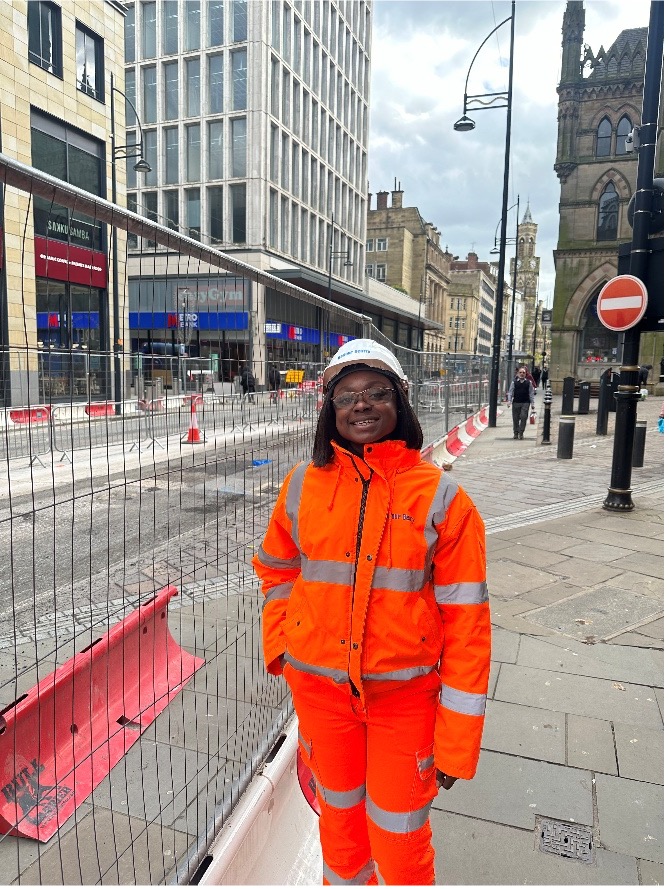

Meet Ruth, an assistant quantity surveyor working for Balfour Beatty.
Name: Ihotu (Ruth) Ocheche
Job Title: Assistant Quantity Surveyor
Company: Balfour Beatty
Years in the Industry: 3 years
One word to describe your job: Adventurous
1. What tasks and activities does your role typically involve?
As an Assistant Quantity Surveyor, I work within the commercial team, supporting the delivery of infrastructure projects from procurement through to final account. My responsibilities include procurement, subcontract management, cost reporting, forecasting, valuations, and assisting with the effective commercial management of projects.
I work closely with project teams and supply chain partners to manage commercial risks, resolve challenges and support informed decision-making throughout the project lifecycle.
2. What inspired you to follow this career path?
My route into quantity surveying was not a traditional one. While studying for a Master's degree in Financial Management, I worked as a cleaner for a Tier 1 construction company. At the time, I viewed construction as an industry centred around hard labour, muddy boots and a predominantly male workforce.
Working in that environment opened my eyes to the wide range of professional careers behind the scenes, from quantity surveyors and planners to project managers and commercial teams. Until then, I had not realised how diverse the industry really was.
Coming from a finance background, quantity surveying immediately stood out to me. I enjoyed finance, but I found the idea of applying those skills to live infrastructure projects much more exciting than a traditional finance role. Watching projects develop and seeing the real-world impact they had made the profession feel meaningful and rewarding.
3. What education path did you take to get into your role?
My educational journey took a few unexpected turns. It started with a Bachelor's degree in Business Management and Finance, followed by a Master's degree in Financial Management. My original ambition was to become a financial analyst, so I completed the Chartered Financial Analyst (CFA) Level I qualification and was awarded a scholarship to progress to CFA Level II.
However, after discovering quantity surveying, I decided to take my career in a different direction. I returned to university to complete a Master's degree in Quantity Surveying while working as a Graduate Quantity Surveyor, which allowed me to develop my knowledge both academically and on live projects.
Looking back, that combination of learning and practical experience gave me a strong foundation and ultimately led me to the career I have today.
4. What is the most valuable thing you have learnt so far within your role?
The most valuable thing I have learnt so far is the importance of people and relationships. When I first entered the profession, I thought quantity surveying was mainly about numbers and cost management. While those are important, I have learnt that successful project delivery depends just as much on communication, collaboration and building strong relationships with colleagues, clients and supply chain partners.
5. What excites you most about working in the industry?
What excites me most about working in the industry is seeing a project evolve from an idea into something real. In many ways, a project becomes like your baby - you watch it grow and develop over time, navigating challenges, celebrating milestones and contributing to its success.
There is a real sense of pride in knowing you have played a part in delivering something that will benefit people and communities for years to come. For me, one of the most rewarding moments is driving past a project and being able to say, "I was part of that."
Knowing that your work has left a lasting impact is what makes the industry so exciting!
6. What advice would you give to someone thinking about following your career path?
Quantity surveying is a profession where no two days are the same, and there is always something new to learn. The people around you can be one of your greatest resources, whether that is colleagues, mentors, or professional bodies such as CICES. There is a whole community of people willing to share their knowledge and experiences, so do not be afraid to ask questions and make the most of those opportunities.
One of the biggest lessons I have taken from the profession is that technical skills are only part of the job. Quantity surveying is as much about people as it is about numbers, and building relationships, communicating effectively, and learning from others will often take you further than trying to do everything yourself.
7. What is your favourite benefit of CICES membership?
My favourite CICES member benefit is the access to CPD opportunities and the professional network. Throughout my career, I've learnt that some of the most valuable lessons come from the people around you. CICES provides access to a wealth of knowledge and experience through its members, events and professional development opportunities, which I find incredibly valuable for supporting my continuous learning and growth.
What’s one myth you’d love to bust about your profession?
‘Construction is just for men and their muddy boots’. Women are just as much a part of the industry!